Gummy vs Soft Chew: Which Format Works Better for High-Load Supplements?
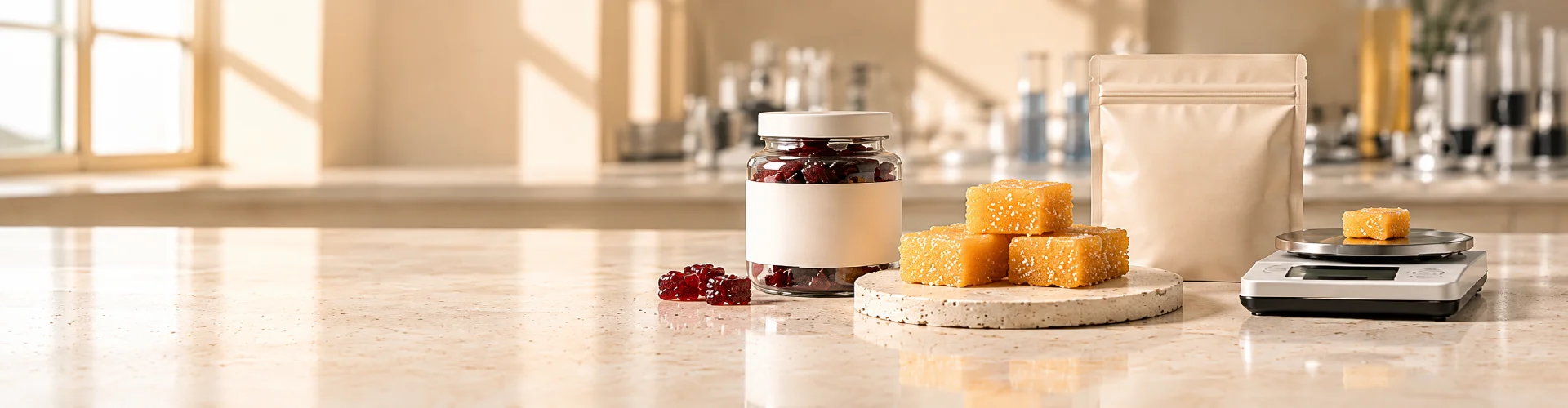
Gummies and soft chews are both portable, chewable supplement formats, but they do not solve high-dose formulation problems in the same way.
A gummy depends on a hydrocolloid gel network and a controlled water-and-solids system. A soft chew usually uses a denser fat, carbohydrate, protein, or mixed matrix with a confection-like bite. That can create more room for gram-level powders, but it also introduces oxidation, fat migration, crumbling, and different processing risks.
The better format is the one that delivers the intended dose in a practical serving while meeting texture, testing, stability, packaging, and cost requirements.
Quick Answer
Compare the Complete Product System
Evaluate:
-
Raw active mass per serving
-
Unit weight and units per serving
-
Solubility, particle size, density, and taste
-
Required texture and consumer ritual
-
Heat, water, acid, and oxygen sensitivity
-
Mixing, forming, or depositing equipment
-
Finished-product method suitability
-
Moisture, water activity, and fat stability
-
Package barrier and distribution conditions
-
Cost per verified serving
Soft chews often offer greater mass capacity. Gummies can offer a familiar elastic texture and strong visual appeal. Neither is universally superior.
Structural Difference
Gel Network vs Dense Chew Matrix
Gummies derive shape and chew from pectin, gelatin, starch, agar, gellan, or blends. The formula must maintain a workable balance of water, solids, gel ingredients, acid, and active load.
Soft chews may use fats, syrups, proteins, fibers, starches, emulsifiers, and powders to create a malleable mass. They may be cut, formed, extruded, or otherwise portioned instead of deposited as a fluid gummy mass.
This distinction affects ingredient capacity, temperature, texture, cleaning, weight control, and shelf-life failure modes.
Dose Capacity
Raw-Material Mass Determines the Format Pressure
High-dose creatine, collagen, amino acids, electrolytes, and minerals can require multiple grams of raw material per serving.
A gummy must reserve meaningful mass for its gel and solids system. A soft chew can often accommodate more powder in a larger, denser unit, although practical limits still depend on cohesion, oil binding, flavor, and processing.
Request a serving-level mass balance for both formats. Do not compare one gummy with one soft chew unless their delivered doses are equal.
Serving Size
Consumer Convenience Has Two Dimensions
Gummies may require several units to reach a gram-level dose. Soft chews may reduce unit count by using larger pieces.
A large soft chew can take longer to consume and may feel dense or dry. Several gummies can create repeated sweetness, sourness, and chewing.
Test the full daily serving for chew time, mouthfeel, aftertaste, portability, and ease of routine.
Active Distribution
Powders Must Stay Uniform
Gummy mass may suspend powders during a heated hold and depositing step. Settling can create beginning-to-end potency differences.
Soft-chew mass may have less free-flowing liquid but can still develop powder agglomeration, fat separation, or incomplete mixing. Cutting or forming must produce consistent unit weight.
Both formats need a defined mixing sequence, commercial sampling, and finished-product verification.
Texture
The Failure Modes Are Different
Gummies can become hard, soft, sticky, rubbery, cracked, weeping, or deformed. High active load can weaken or interrupt the gel.
Soft chews can become crumbly, oily, dry, tough, sticky, grainy, or structurally weak. Fat crystallization and migration can change bite over time.
Approve texture after production and during stability—not only in a fresh laboratory sample.
Taste Masking
More Matrix Space Can Help, but Dose Still Dominates
Gummies use sweetness, acidity, aroma, and coating to manage flavor. Acid can be useful for fruit profiles but may be undesirable for acid-sensitive actives.
Soft chews may use cocoa, nut-like, caramel, dairy-style, fruit, or other profiles and can incorporate fats that modify flavor release. Fat can also carry or prolong certain off-notes.
Evaluate bitterness, saltiness, chalkiness, cooling, powder perception, aroma, and aftertaste at the complete serving.
Heat, Water, and pH
Choose the Environment the Active Can Tolerate
Gummies usually expose the product to water, heat, and an acidic or controlled-pH system. Sensitive actives may require late addition, reduced exposure, or a different format.
Soft chews may use less available water and a different pH environment, but mixing, cooking, or forming can still generate heat. Fat and oxygen introduce other degradation pathways.
Map the active's risks against the actual process rather than the format name.
Moisture and Water Activity
Both Formats Need Product-Specific Control
Moisture content and water activity are related but different. Gummies and soft chews can reach similar water activity through different ingredient systems and still have different textures.
Set targets from microbial controls, process capability, texture, package barrier, and stability. Do not transfer a gummy moisture specification directly to a soft chew.
Oxidation and Fat Stability
Soft Chews Add Lipid Questions
When a soft chew contains meaningful fat or oil, review fatty-acid profile, antioxidants, oxygen exposure, mixing, package barrier, flavor protection, and rancidity indicators.
Oil-based actives may integrate well but can migrate or interact with the matrix. Gummies can also contain oils or emulsions, although the risk profile differs.
Manufacturing Equipment
The Production Path Changes the Scale-Up Risk
Gummy production may include cooking, vacuum, mixing, transfer, depositing, setting, drying, coating, and counting.
Soft-chew production may include dry and wet mixing, fat or syrup incorporation, temperature conditioning, forming, cutting, dusting or wrapping, and packaging.
Ask whether the manufacturer has run a comparable load on the relevant commercial equipment—not merely made a hand sample.
Finished Testing
The Matrix Must Release the Analyte in the Laboratory
Hydrocolloids, sugars, fibers, fats, proteins, colors, flavors, and coatings can affect sample preparation and analytical recovery.
Confirm method suitability separately for each format. Use representative sampling and clear per-unit or per-serving calculations. A method verified for powder or gummies may require additional work for a fatty soft-chew matrix.
Stability and Packaging
The Launch Pack Is Part of the Formula
Gummies may need protection from heat and humidity to prevent sticking or hardening. Soft chews may need moisture and oxygen control plus protection from oil migration, deformation, or flavor loss.
Compare bottle, pouch, individual wrap, blister, seal, headspace, desiccant or oxygen absorber suitability, package count, and freight. Place the intended commercial configuration on stability.
Cost and MOQ
Compare Per Serving and by Constraint
Soft chews may use larger units, individual wraps, or specialized forming equipment. Gummies may require molds, drying capacity, coating, and higher count per serving.
Ask what drives MOQ: batch size, ingredient minimum, forming or depositor setup, wrapper film, printed pouch, bottle count, or testing cost.
Compare total cost per verified serving, package, and delivered order.
Format Decision Scorecard
Favor gummies when:
-
The dose fits a practical unit count
-
Elastic or fruit-style sensory is central
-
The active tolerates the matrix and process
-
Package and stability are controlled
Favor soft chews when:
-
Raw-material mass is difficult for gummies
-
A larger dense unit is acceptable
-
Lower-acid or different flavor profiles help
-
The brand can manage fat, texture, and wrapping risks
Common Mistakes
-
Comparing unequal doses
-
Assuming soft chews have unlimited capacity
-
Approving one unit instead of a full serving
-
Ignoring fat oxidation in soft chews
-
Ignoring pH and water exposure in gummies
-
Using the same test preparation for both matrices
-
Quoting MOQ without packaging constraints
-
Borrowing shelf life across formats
How VitaMFG Compares High-Load Formats
Start With the Ingredient Mass Balance
VitaMFG reviews active basis, raw-material mass, serving count, unit weight, ingredient behavior, consumer, sensory target, market, package, testing, volume, and target price.
Gummy feasibility is evaluated around gel structure, pH, suspension, depositing, drying, and water activity. Soft-chew feasibility adds cohesion, fat or syrup behavior, forming, oxidation, and wrapping.
The comparison is made at the full verified serving rather than by category preference.
Frequently Asked Questions
Can soft chews always carry more active than gummies?
They often provide more mass capacity, but practical limits remain. Texture, cohesion, flavor, processing, oxidation, package, and consumer use must still work.
Are soft chews the same as gummies?
No. Their structural systems and manufacturing methods can be materially different, even though both are chewable.
Which format has better stability?
Neither by default. Stability depends on the active, formula, water activity, pH, oxygen, process, package, and storage.
Which has a lower MOQ?
It depends on equipment, batch size, ingredients, tooling, wrapping or packaging, and the manufacturer's platform.
Final Recommendation
Select gummies or soft chews by testing the complete dose-format-package system.
Compare raw-material mass, serving burden, process exposure, texture, method suitability, stability, packaging, and cost per serving before approving the platform.
VitaMFG can compare the initial feasibility of gummy and soft-chew routes for a high-load supplement concept.
Reference Links
-
Electronic Code of Federal Regulations: 21 CFR Part 111 — https://www.ecfr.gov/current/title-21/chapter-I/subchapter-B/part-111
-
FDA: Water Activity in Foods — https://www.fda.gov/inspections-compliance-enforcement-and-criminal-investigations/inspection-technical-guides/water-activity-aw-foods