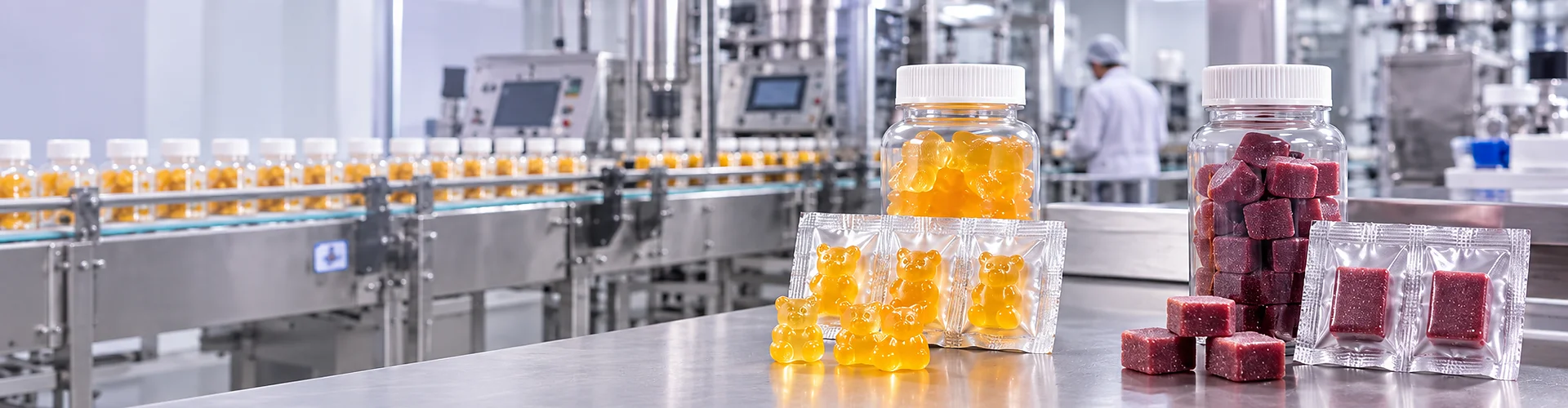
Creatine Soft Chews: Why High-Load Formats Could Be the Next Category Extension
Creatine powder built the category around efficient gram-level dosing. Gummies expanded the conversation toward convenience and flavor but face tight limits when a brand wants a meaningful dose in a small serving.
Soft chews create another option: a larger, denser chewable unit that can potentially carry more creatine material than a conventional gummy while preserving portability and pre-portioned use.
That opportunity is real only when the product delivers a credible serving, remains pleasant to consume, can be manufactured repeatedly, and maintains potency and texture through shelf life.
Quick Answer
A Format Extension, Not a Shortcut
Creatine soft chews may offer:
-
More formula mass per unit
-
Fewer pieces per gram-level serving
-
A distinct portable ritual
-
Flavor profiles beyond sour fruit gummies
-
Premium single-serve or wrapped presentation
-
Portfolio separation from tubs and gummies
They also require control of powder distribution, unit weight, cohesion, texture, heat, moisture, fat or syrup behavior, oxidation where relevant, finished testing, package barrier, and cost per serving.
Why the Category Needs Another Format
Consumer Convenience and Dose Efficiency Still Conflict
Powder delivers creatine efficiently but requires measuring and mixing. Gummies are easy to carry but can require several units and a high proportion of active powder.
A soft chew can occupy the middle: more active mass in a chewable piece, without a scoop or beverage.
The format can serve travel, workplace, gym-bag, sampling, and subscription occasions. It should solve a defined use case rather than exist only because it is novel.
Dose Capacity
Larger Units Create More Formula Space
Soft chews can be made as larger, denser pieces than conventional gummies and may reserve less of the unit for a hydrocolloid gel network.
This can reduce the number of pieces required for a gram-level serving. It does not eliminate constraints: the matrix still needs enough binder, fat or syrup, solids, flavor, and structure to form, cut or extrude, package, and remain acceptable.
Request a complete mass balance for raw creatine material, excipients, unit weight, pieces per serving, and servings per package.
Serving Architecture
One Large Chew Is Not Always More Convenient
An oversized piece can become dry, dense, or tiring to chew. Several smaller pieces increase count and package volume.
Evaluate:
-
Creatine basis per piece and serving
-
Piece dimensions and weight
-
Pieces per daily serving
-
Chew time
-
Mouth coating and powder perception
-
Flavor buildup and aftertaste
-
Individual wrapping or loose fill
The complete serving should be tested by target users.
Matrix Design
Soft Chews Use Different Structural Tools
Depending on the product platform, a soft chew may combine carbohydrates, fibers, proteins, fats, syrups, starches, emulsifiers, flavors, and binding components.
The system must hold a large suspended powder load without crumbling, oiling out, sticking, becoming hard, or deforming.
The exact route affects dietary positioning, allergens, oxidation, water activity, temperature, equipment, packaging, and shelf life.
Creatine Distribution
High Average Potency Is Not Enough
Creatine powder must be dispersed evenly through the mass. Agglomeration or incomplete mixing can create piece-to-piece variation.
Control raw-material particle grade, preblend, addition sequence, mixing time and load, batch temperature, hold, transfer, and forming.
Commercial sampling should cover multiple points in the batch and run. Combine unit-weight data with finished potency results.
Texture and Powder Perception
High Load Can Make a Chew Feel Like Compressed Powder
The product may become chalky, crumbly, gritty, dry, pasty, or mouth-coating as creatine load rises.
More binder can improve cohesion but reduce dose capacity or create stickiness. More fat may improve lubrication but introduce oil migration or oxidation. More syrup can change water activity and package needs.
Texture development is a balance, not a single-ingredient fix.
Flavor Strategy
Soft Chews Expand the Sensory Palette
Gummies often favor bright fruit and sour profiles. Soft chews can support fruit, caramel, cocoa, vanilla, nut-like, dairy-style, or other concepts depending on the matrix and allergen strategy.
Creatine itself may still create powder perception or mineral-like notes. Approve flavor at the target dose and full serving, including stored samples.
Avoid using excessive acid merely to reproduce a gummy profile if a lower-acid environment is part of the soft-chew rationale.
Heat, Moisture, and Stability
A Lower-Acid Product Still Needs Evidence
Soft chews may expose creatine to a different balance of water, pH, heat, and oxygen than gummies. This can change risk but does not guarantee stability.
Track process temperature and time, final moisture, water activity, pH where relevant, package barrier, and storage. Monitor finished creatine through the intended shelf life.
If the formula contains meaningful fat, include oxidation and flavor stability in the evaluation.
Finished Potency Testing
Verify the Matrix and the Serving
The analytical method must recover creatine from the complete soft-chew matrix, which may include fats, fibers, proteins, cocoa, flavors, and coatings.
Review homogenization, extraction, specificity, recovery, precision, report units, and conversion to per piece or serving. When relevant, evaluate creatinine as a degradation indicator.
Raw-material assay and theoretical input do not replace finished-product results.
Manufacturing Scale-Up
Forming Equipment Changes the Product
Commercial soft chews may be mixed, sheeted, extruded, cut, molded, or formed through another controlled process. Equipment imposes limits on temperature, mass consistency, particle size, pressure, and unit weight.
The trial should record:
-
Formula revision and batch size
-
Mixing sequence and conditions
-
Mass temperature and hold time
-
Forming or cutting settings
-
Beginning-middle-end unit weights
-
Yield and rework
-
Finished potency and physical results
-
Package performance
A hand-rolled sample is not commercial evidence.
Packaging Options
The Format Can Create New Brand Rituals
Individual wraps can support portability, sampling, premium presentation, and unit protection. They also add material, machinery, print minimums, cost, and seal requirements.
Bottles or pouches can reduce wrapping but may allow pieces to abrade, stick, migrate oil, exchange moisture, or deform.
Compare barrier, seal, headspace, count, consumer opening, sustainability goals, freight, and stability in the intended configuration.
Cost per Serving
Premium Positioning Must Support the Economics
Creatine soft-chew cost can include a large ingredient mass, specialized matrix, forming, individual wrapping, testing, stability, and larger package volume.
Model:
-
Verified creatine per serving
-
Pieces and packages per batch
-
Ingredient and flavor cost
-
Process yield and waste
-
Wrapper or container cost
-
Freight and fulfillment
-
Channel margin
-
Target retail price
Compare with powder and gummies at equal daily doses.
Portfolio Strategy
Give Each Format a Job
A brand can position:
-
Powder as the value and dosing-efficiency platform
-
Gummies as the familiar, flavorful, lighter-dose convenience platform
-
Soft chews as the high-load portable or premium platform
The products should have distinct consumers, occasions, flavors, package sizes, and price logic. Avoid launching three formats with identical communication and no clear reason to choose.
Claims and Market Fit
Innovation Does Not Change the Regulatory Standard
The label should state serving size, creatine form and amount, directions, and required information accurately. Claims must be appropriate and substantiated for the target market.
Do not describe the product as FDA approved. Do not imply that soft-chew delivery is clinically superior without evidence.
For sports markets, distinguish facility GMP credentials, product certification, and banned-substance testing.
Commercial Opportunity Checklist
A strong extension has:
-
A defined consumer and use occasion
-
A meaningful, transparent serving
-
Better convenience than powder for that occasion
-
Greater dose practicality than the proposed gummy
-
Acceptable full-serving sensory performance
-
Commercial scale-up evidence
-
Finished potency and stability
-
Package and margin fit
-
Clear portfolio differentiation
Red Flags
-
The format is selected before dose calculation
-
A low-load prototype is used for launch approval
-
Soft chews are described as having unlimited capacity
-
Piece weight is not connected to potency
-
No commercial forming trial exists
-
A gummy test method is assumed to fit the chew
-
Packaging is selected after stability begins
-
The product duplicates powder without a distinct use case
How VitaMFG Evaluates Creatine Soft Chews
Connect High Load to a Repeatable Consumer Product
VitaMFG reviews the creatine basis, target serving, piece weight, maximum piece count, matrix, flavor, market, package, testing, volume, and price expectations.
Feasibility then connects powder distribution, cohesion, texture, heat and moisture exposure, forming, unit weight, finished potency, stability, and packaging.
Where a soft chew does not improve dose practicality or portfolio fit, powder, gummy, capsule, or another platform can be compared before development investment.
Frequently Asked Questions
Can a soft chew contain more creatine than a gummy?
It may accommodate more raw material per unit, but the practical amount depends on matrix, texture, forming, testing, stability, package, and consumer use.
Are creatine soft chews sugar-free?
Not automatically. The claim depends on the complete formula and target-market rules. Sugar-free versions require a dedicated structural and labeling strategy.
Do soft chews need individual wrappers?
Not always. The decision depends on piece stability, sticking, moisture, oil migration, portability, machinery, cost, and brand experience.
Can soft chews replace powder?
They can complement or replace powder for specific consumers and occasions, but powder often retains an advantage in dose efficiency and cost.
Final Recommendation
Treat creatine soft chews as a strategic format extension, not a novelty.
Prove that the format improves the full serving, consumer ritual, commercial economics, and portfolio role. Then validate distribution, texture, finished potency, scale-up, package, and shelf life.
VitaMFG can review whether a creatine soft-chew platform fits your next category extension.
Reference Links
-
International Society of Sports Nutrition Position Stand: Creatine Supplementation — https://pmc.ncbi.nlm.nih.gov/articles/PMC5469049/
-
Review: Bioavailability, Efficacy, Safety, and Regulatory Status of Creatine and Related Compounds — https://pmc.ncbi.nlm.nih.gov/articles/PMC8912867/
-
FDA: Questions and Answers on Dietary Supplements — https://www.fda.gov/food/information-consumers-using-dietary-supplements/questions-and-answers-dietary-supplements
-
Electronic Code of Federal Regulations: 21 CFR Part 111 — https://www.ecfr.gov/current/title-21/chapter-I/subchapter-B/part-111