How to Evaluate a Supplement Manufacturer’s Real R&D Capability
Almost every supplement manufacturer says it offers research and development. The phrase may describe anything from changing a flavor in a stock formula to building and validating a new high-load delivery system.
Real R&D capability is not measured by the number of samples a factory can ship. It is the ability to convert a product brief into a manufacturable specification, identify technical conflicts, generate useful evidence, transfer the formula to commercial equipment, and reproduce the result.
Brands should evaluate the decisions and records behind the sample—not only its appearance.
Quick Answer
Look for a Complete Evidence Chain
A capable R&D partner should demonstrate:
-
Structured review of the product brief
-
Ingredient and format-specific formulation knowledge
-
Clear feasibility limits and trade-offs
-
Controlled sample formulas and revisions
-
Access to relevant pilot or commercial equipment
-
Finished-product testing and method review
-
Planned scale-up and commercial trials
-
Stability and package evaluation
-
Documented failures, investigations, and changes
-
Transfer to repeat production
The strongest signal is not “yes.” It is a clear explanation of what must be proven before the manufacturer can say yes responsibly.
Product-Brief Review
R&D Begins Before the First Formula
A useful development team asks about target dose, ingredient form, serving count, dosage form, sensory target, market, claims, package, shelf life, testing, order volume, price expectations, and timeline.
These variables interact. A high dose may conflict with unit size. A vegan requirement can change the gel system. A sugar-free claim can change texture and water activity. A low MOQ may limit ingredient and packaging choices.
If the manufacturer quotes immediately without resolving these points, the project may not have received a real feasibility review.
Formulation Judgment
The Team Must Explain Why the Formula Works
Ask the developer to describe the functional role of major excipients, the active's physical behavior, expected process window, and primary risks.
Strong answers connect ingredient properties to manufacturing. For example, they may discuss particle suspension, flow, emulsion, pH, buffering, moisture, water activity, capsule fill density, powder segregation, or softgel shell compatibility.
Generic statements such as “our proprietary technology solves it” should be supported by measurable attributes and controlled records.
Feasibility Limits
Good R&D Includes Saying No or Not Yet
Some concepts cannot meet every requested dose, serving size, claim, texture, shelf life, MOQ, and price simultaneously.
A capable team identifies the conflict and proposes options, such as:
-
Change unit weight or serving count
-
Select another ingredient grade
-
Modify the sweetener or gel system
-
Adjust package barrier
-
Use a different dosage form
-
Separate incompatible actives
-
Plan a longer stability program
A factory that accepts every concept without qualification may be transferring risk to the commercial batch.
Sample Controls
A Sample Must Have an Identity
Each sample should connect to a formula revision, ingredient lots or controlled materials, process notes, date, and evaluation purpose.
The brand should know what changed between rounds. “Sample B tastes better” is less useful than a documented record showing which acid, flavor, particle grade, process, or solids parameter changed and why.
Uncontrolled samples are difficult to reproduce or transfer.
Equipment Relevance
Bench Tools Must Connect to the Production Line
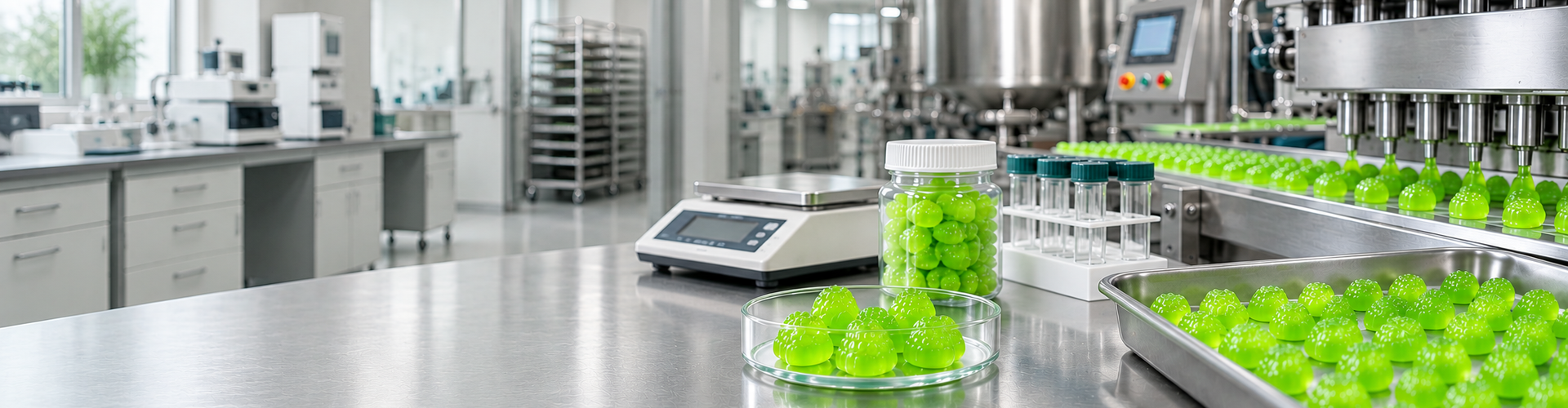
Laboratory equipment helps screen concepts, but its mixing, heat transfer, shear, depositing, drying, encapsulation, blending, or filling conditions may differ from commercial equipment.
Ask how the team models scale effects and when pilot or commercial trials occur. A manufacturer should understand which parameters can be scaled directly and which require process redevelopment.
Analytical Capability
R&D Is Incomplete Without Measurement
The team should identify which attributes require in-process checks and finished testing. Depending on format, these may include potency, identity, unit weight, fill weight, pH, moisture, water activity, particle size, blend uniformity, viscosity, disintegration, microbiology, contaminants, and package integrity.
Laboratory methods must be suitable for the matrix. R&D should work with quality and external laboratories to resolve extraction, recovery, interference, units, and specifications.
Scale-Up Planning
Sample Approval Is Not Commercial Approval
A credible transfer path may include feasibility, laboratory sample, pilot or engineering batch, commercial trial, finished testing, stability placement, and repeat production.
The plan should identify critical process parameters, critical quality attributes, sampling, acceptance criteria, deviations, and decision owners.
Ask for examples of how beginning-middle-end sampling, unit or fill weight, yield, and finished assay were used to evaluate a commercial run.
Stability Strategy
R&D Must Design for the Intended Package
Shelf-life work begins with formulation and package decisions, not after inventory is made.
The team should identify likely degradation or physical-change pathways and select meaningful test attributes. Accelerated studies can compare options and reveal risk, while real-time data in the intended package supports the commercial shelf-life conclusion.
Be cautious when every formula receives the same expiry without product-specific evidence.
Failure Analysis
The Best Evidence Often Comes From Problems
Ask how the team handles a gummy that sticks, a powder that segregates, a capsule with fill-weight drift, a softgel that leaks, or a potency result outside expectation.
A strong process documents the observation, investigates likely causes, changes one or more controlled variables, evaluates results, and updates the formula or process record.
Repeated random reformulation without a hypothesis is not robust development.
Documentation and Change Control
Knowledge Must Survive Beyond One Developer
R&D records should connect the approved formula to master manufacturing instructions, specifications, test methods, packaging, and stability.
Changes to active supplier, excipient grade, flavor, color, process, site, equipment, package, or test method should be assessed for impact and approved through an appropriate process.
If production depends on one person's memory, the system is not ready for reliable reorder supply.
Cross-Functional Access
Formulators Need Quality and Operations
Commercial development involves R&D, production, quality assurance, quality control, regulatory or labeling, procurement, packaging, and project management.
Ask whether the brand can reach technical and quality staff when decisions arise. A sales-only communication chain can hide uncertainty and delay corrective action.
Relevant Experience
Category Labels Are Not Enough
“We make gummies” does not prove experience with a gram-level mineral gummy. “We make powders” does not prove control of a low-dose botanical premix.
Ask for anonymized evidence from technically comparable work: dose range, ingredient behavior, format, commercial batch history, methods, stability, and lessons learned. Protecting customer confidentiality is reasonable; refusing to discuss any process evidence is less reassuring.
Commercial Reality
R&D Must Fit MOQ, Cost, and Supply
A brilliant sample can fail as a product if it requires unavailable materials, uneconomic packaging, excessive waste, an unrealistic MOQ, or a process the factory cannot schedule.
Review development fees, sample rounds, ingredient minimums, testing cost, commercial MOQ, expected yield, packaging minimums, lead time, and reorder capacity.
R&D Evaluation Scorecard
Score the manufacturer on:
-
Product-brief quality
-
Format-specific technical reasoning
-
Transparency about constraints
-
Sample revision control
-
Commercial equipment relevance
-
Analytical and quality integration
-
Scale-up evidence
-
Stability design
-
Failure investigation
-
Documentation and repeatability
Weight the categories according to project risk. A custom high-load product needs more evidence than a lightly modified stock formula.
Red Flags
-
Every concept is approved immediately
-
No formula revision appears on samples
-
The sales team cannot arrange technical discussion
-
“Pilot” and “commercial” are used interchangeably
-
Raw-material COAs replace finished testing
-
Shelf life is copied from another formula
-
Failed samples have no documented cause
-
Packaging is excluded from development
-
Production instructions depend on operator memory
-
No evidence exists from repeat batches
How VitaMFG Approaches R&D Projects
Develop Toward Commercial Evidence
VitaMFG begins with the product and business brief. The formulation route is reviewed around dose, ingredient behavior, format, sensory target, market, package, testing, volume, and timeline.
Development connects samples to controlled revisions, manufacturing feasibility, finished specifications, analytical methods, commercial scale-up, and stability. Where the original concept creates a technical or commercial conflict, alternatives are discussed before the brand commits to launch inventory.
Frequently Asked Questions
How many samples prove strong R&D?
The number alone proves little. Each round should answer a defined question and move the formula toward a controlled commercial specification.
Does an in-house laboratory prove R&D strength?
No. Equipment is useful only when methods, staff competence, sample control, interpretation, and quality decisions are appropriate.
Should a manufacturer share the full formula?
Ownership and disclosure depend on the commercial agreement. The brand should still understand specifications, claims, allergens, active basis, testing, and change-control responsibilities.
Can R&D be evaluated before placing an order?
Yes. Review the brief process, technical questions, sample controls, comparable scale-up evidence, documentation, and project plan.
Final Recommendation
Evaluate R&D by the manufacturer's ability to reduce uncertainty.
The right partner should explain constraints, control sample revisions, connect formulation to testing and equipment, investigate failures, and reproduce the product at commercial scale.
VitaMFG can review your product brief and identify the initial technical questions that should be resolved before formal development.
Reference Links
-
Electronic Code of Federal Regulations: 21 CFR Part 111 — https://www.ecfr.gov/current/title-21/chapter-I/subchapter-B/part-111
-
FDA: Current Good Manufacturing Practice for Dietary Supplements — https://www.fda.gov/regulatory-information/search-fda-guidance-documents/small-entity-compliance-guide-current-good-manufacturing-practices-manufacturing-packaging-labeling-or-holding-operations-dietary-supplements
-
ICH: Q1A(R2) Stability Testing of New Drug Substances and Products — https://database.ich.org/sites/default/files/Q1A%28R2%29%20Guideline.pdf