Accelerated vs Real-Time Stability Testing for Gummies
Accelerated and real-time stability testing answer related but different questions. Accelerated conditions can reveal vulnerabilities sooner and help compare formulas or packages. Real-time studies show how the finished gummy performs under its intended labeled storage condition.
Neither study creates shelf life automatically. The evidence is only meaningful when it identifies the exact formula, commercial package, storage conditions, time points, test methods, specifications, and trend.
For gummies, stability must consider both active potency and physical quality. A product can meet assay requirements and still become sticky, hard, cracked, wet, discolored, or unpleasant before expiry.
Quick Answer
Use Both Studies for Different Decisions
Accelerated testing is useful for:
-
Identifying early failure modes
-
Comparing formula or package versions
-
Supporting risk-based development decisions
-
Generating preliminary trend information
Real-time testing is useful for:
-
Observing the product under labeled storage conditions
-
Building product-specific shelf-life evidence
-
Confirming physical and sensory performance over time
-
Reviewing whether the package remains protective
Do not convert a short accelerated study into a long commercial shelf life through a universal rule. Chemical reactions, moisture migration, texture changes, color loss, and microbial behavior may respond differently to temperature and humidity.
Define the Stability Question
The Study Must Support a Decision
Common questions include:
-
Does the active remain within specification?
-
Does a sugar-free base remain soft without sticking?
-
Does one bottle protect better than one pouch?
-
Does a color or flavor remain acceptable?
-
Does a high-load gummy maintain unit integrity?
-
Does an overage support the end-of-shelf-life target?
-
Does transport heat create a physical failure?
The protocol should state the intended shelf life and the decisions that will be made from each time point.
What Real-Time Testing Means
Store the Product Under Its Intended Condition
Real-time, or long-term, testing follows the packaged product under the storage conditions intended for the label and market.
The study should use the commercial formula, process, and package. If development samples are used initially, later commercial batches should be incorporated into the evidence plan.
Real-time data is slow because it follows actual time. That is its value. It captures changes that accelerated testing may distort or miss.
The protocol should identify temperature, humidity where controlled, package orientation if relevant, time points, tests, acceptance criteria, sample quantity, and responsibilities.
What Accelerated Testing Means
Increase Stress to Reveal Risk Earlier
Accelerated studies use elevated temperature, humidity, light, or other stress to speed certain changes. They can help rank prototypes and detect obvious failures before a full real-time program is complete.
For example, accelerated storage may show that one package allows rapid moisture gain, one flavor fades, or one gummy hardens more quickly.
The conditions should be justified for the product and market. Pharmaceutical ICH guidelines provide widely known stability frameworks, but dietary supplements are not automatically governed by the same product-specific requirements. Brands should use such guidance as technical background, not misrepresent it as a universal legal schedule for gummies.
Why Simple Time Multipliers Are Risky
Not Every Change Follows the Same Kinetics
It is tempting to say that one month at a high temperature equals a fixed number of months at room temperature. That may be inappropriate.
Temperature can accelerate chemical reactions, but gummy texture also depends on moisture transfer, glass transition, crystallization, gel relaxation, package permeability, and formulation.
High heat can create a failure mechanism that does not occur under normal storage, or it can miss a slow issue driven by light or oxygen. Humidity can affect package and product differently.
Use accelerated trends to identify risk and compare options. Establish the final shelf-life rationale from the full evidence set.
Select Stability Attributes
Potency Is Only One Part of Gummy Quality
Depending on the formula, monitor:
-
Active content
-
Degradation products where relevant
-
Microbiology
-
Moisture content
-
Water activity
-
pH
-
Texture or firmness
-
Stickiness and surface condition
-
Color, odor, flavor, and aftertaste
-
Gummy weight and dimensions
-
Package integrity
Choose attributes linked to known material, process, and consumer risks. Testing every possible attribute at every time point can waste samples and budget without improving the decision.
Moisture and Water Activity
Follow Both When They Drive Physical Stability
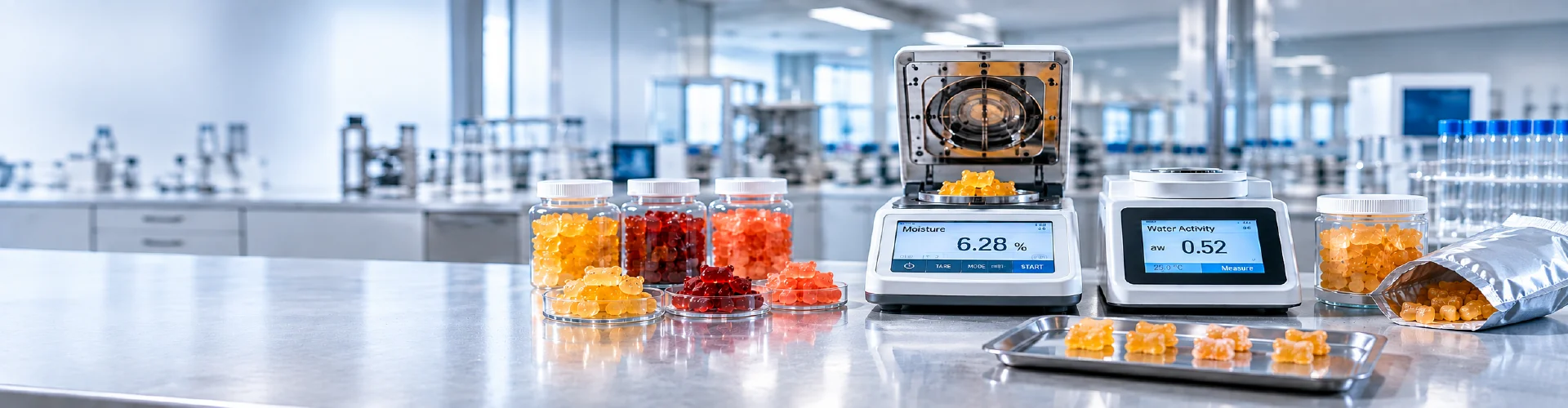
Moisture content measures total water. Water activity reflects water availability. A gummy can lose a small amount of moisture and become much harder, or gain moisture and become sticky.
Polyols, fibers, salts, acids, and actives change water binding. Sugar-free and high-load gummies may therefore need different specifications from standard vitamin gummies.
Record equilibrium time before measurement and use consistent methods. Compare results with texture and package data rather than interpreting one number in isolation.
Active Potency and Degradation
Use Methods Suitable for the Finished Matrix
The protocol should define the analyte, method, reporting units, specification, and sample preparation. Gummies contain sugars or fibers, hydrocolloids, acids, colors, flavors, and multiple actives that may interfere with extraction.
For sensitive ingredients, monitor a relevant degradation product when it improves interpretation. A declining active result alone may not show whether the cause is true degradation, poor recovery, nonuniform sampling, or analytical variation.
Use batch-specific initial results as the study baseline. Theoretical input is not a reliable time-zero value.
Sensory and Texture Review
Use Controlled Criteria
Sensory evaluation should be more structured than “still tastes good.” Define reference samples, panel, attributes, scale, and acceptance boundaries.
Review the complete serving for:
-
Initial bite and chew resistance
-
Grittiness or powder perception
-
Sweetness and acidity
-
Active aftertaste
-
Aroma and color
-
Surface oil, sugar bloom, or sticking
-
Shape retention
Photography under consistent lighting can support appearance trending, but it should not replace measurements and controlled observations.
Package the Study Product Correctly
Shelf Life Belongs to Formula Plus Package
Run stability in the proposed commercial bottle, pouch, blister, or individual wrap, including liner, desiccant, and closure as applicable.
A bulk bag or laboratory jar does not represent consumer packaging. Different package materials transmit moisture, oxygen, and light at different rates.
If several packages are being considered, accelerated comparison can help screen them. The selected commercial package should continue in real-time work.
Record package supplier, material, dimensions, seal, headspace, count, and closure so that the study configuration can be reproduced.
Batch Selection and Sample Quantity
Plan Enough Units Before the Study Starts
Stability consumes product at every time point. Calculate the tests, replicates, retains, contingencies, and destructive analyses before placing the batch.
Early development can use one representative batch for risk screening. A stronger commercial program may include multiple production batches depending on product risk and claims.
Do not pool units from different formula revisions or package lots without control. Each sample should be traceable to batch, package, condition, and pull date.
Time Points and Protocol Discipline
Avoid Improvised Testing
The schedule should reflect the intended shelf life, development stage, material sensitivity, and budget. Common programs include early accelerated pulls and longer real-time intervals, but no one schedule fits every gummy.
Define permitted windows for pulling and testing. Record excursions, missed time points, damaged packages, and method changes.
Changing the formula, flavor, active source, process, or package during the study may reduce how directly the data applies to the final product.
Interpreting Trends
Do Not Wait for a Failure to Review the Data
Plot active, moisture, water activity, texture, and other numerical results over time. Review sensory and appearance trends alongside them.
A result can remain within specification while moving steadily toward the limit. That trend may justify reformulation, tighter release targets, a better package, or a shorter shelf life.
Investigate unexpected increases as well as decreases. Sampling variability, nonuniformity, moisture change, calculation basis, and method precision can affect results.
Changes That May Require New Stability Review
-
Active supplier, form, or assay
-
Significant formula or overage change
-
Sugar to sugar-free conversion
-
Gelling-system change
-
Process temperature or hold-time change
-
Different unit weight or drying endpoint
-
New package material or closure
-
New manufacturing site or equipment
-
New storage claim or market condition
Not every change requires restarting every study. Use a documented risk assessment to decide what bridging or new data is needed.
Common Stability Mistakes
-
Testing a laboratory sample in a noncommercial container
-
Using theoretical potency as time zero
-
Monitoring assay but not texture or sticking
-
Calling a short accelerated test a full shelf-life guarantee
-
Applying one temperature multiplier to every attribute
-
Changing formula revision without documenting it
-
Running too few samples for all time points
-
Ignoring package component details
-
Reviewing pass or fail without trend analysis
How VitaMFG Plans Gummy Stability
Build the Protocol From Product Risk
VitaMFG reviews the active ingredients, gummy base, pH, processing exposure, final moisture and water activity, physical targets, commercial package, market, test methods, and intended shelf life.
Accelerated work is used to compare risk and identify early failure modes. Real-time work follows the selected commercial configuration. The protocol can include potency, relevant degradation, microbiology, moisture, water activity, texture, sensory quality, and package performance based on the formula.
Results are interpreted as product-specific evidence rather than a universal guarantee for all gummies.
Frequently Asked Questions
Q1: Can three months accelerated testing prove two years of shelf life?
Not automatically. The relationship depends on the product, attribute, conditions, method, and supporting real-time evidence.
Q2: Must every gummy use the same stability conditions?
No. Conditions and tests should reflect formula, package, market, storage claim, and risk.
Q3: Is a passing active assay enough?
No. Physical, sensory, microbiological, and package attributes may also determine whether the product remains acceptable.
Final Recommendation
Use Accelerated Testing to Learn and Real-Time Testing to Confirm
Accelerated and real-time stability studies should work together. One identifies vulnerabilities sooner; the other shows performance under intended storage.
If you have a gummy formula, package, market, and shelf-life target, VitaMFG can help define the attributes and study structure needed for an initial stability plan.