Creatine Gummy Stability: pH, Moisture and Temperature
Creatine gummy stability cannot be judged from the raw-material certificate or the amount added to the batch. Once creatine enters an acidic, moisture-containing gummy system, its behavior depends on the final formulation, processing history, package, and storage conditions.
Three variables require particular attention: pH, moisture availability, and temperature. They interact with each other, so controlling only one does not prove that the finished gummy will retain its declared creatine content through shelf life.
Quick Answer
There Is No Universal Stability Number
Creatine can convert to creatinine in aqueous systems. Published studies show that the rate generally increases as pH decreases and temperature rises. Water activity also affects molecular mobility and degradation behavior.
For a finished gummy, the practical objective is not to chase one universal pH, moisture percentage, or storage temperature. It is to establish a controlled product window and verify it with the final formula in the final package.
A credible stability program should connect:
-
A defined pH measurement method and operating range
-
Moisture content and water activity targets
-
Controlled heat exposure during manufacturing
-
A package selected for the expected distribution environment
-
Finished-product creatine testing at release and during storage
A gummy can look and taste acceptable while creatine potency changes. Visual appearance is not a substitute for assay data.
What Stability Means for a Creatine Gummy
Potency Is Only One Part of the Decision
A stable commercial gummy should continue to meet its approved specifications for creatine content and other relevant quality attributes. Depending on the product, those attributes may include appearance, texture, unit weight, moisture or water activity, microbiological quality, and package condition.
Cloudiness, crystals, surface moisture, hardening, or sticking may signal a physical change, but none of these observations alone proves how much creatine remains. Conversely, a visually normal gummy may still require analytical confirmation of potency.
Stability should therefore be evaluated as a system: chemical potency, physical performance, microbiological control, packaging, and consumer use must remain commercially acceptable together.
pH: Necessary for the Gummy, Risky for Creatine
Lower pH Can Accelerate Conversion
Acid is normally used to build flavor, support the gel system, and help control product quality. However, creatine is less stable in acidic aqueous conditions than in neutral conditions. Lower pH can accelerate its cyclization to creatinine, particularly when combined with time and heat.
This creates a real formulation trade-off. Raising pH without considering the gel system, taste, and microbiological design is not a safe solution. The correct approach is to define the lowest practical acid exposure that still delivers the required product performance, then verify the result analytically.
Measure pH With a Reproducible Method
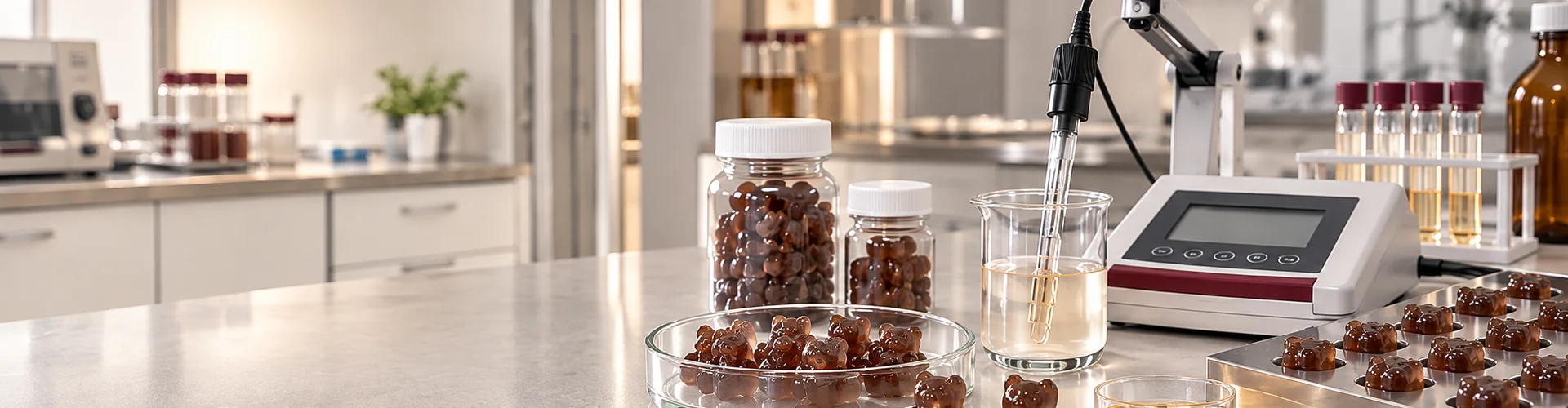
A gummy is not a simple liquid. Results can vary if one laboratory tests a direct probe reading while another tests a diluted or homogenized slurry. The specification should define sample preparation, dilution if used, equilibration, temperature, instrument calibration, and reporting basis.
Trend data is meaningful only when the same method is used consistently. A pH number without a measurement procedure is weak evidence.
Moisture Content Is Not Water Activity
Total Water Does Not Equal Available Water
Moisture Content
This measures the total amount of water in the product under the stated test method. It influences weight, texture, drying yield, and label calculations.
Water Activity
Water activity describes how available the water is within the product system. It is relevant to microbial behavior, texture change, moisture migration, and some chemical reactions.
Two gummies can have similar moisture content but different water activity because sugars, polyols, fibers, salts, hydrocolloids, and functional ingredients bind water differently. Moisture percentage should not be used as an automatic substitute for water activity.
Why This Matters for Creatine
Research using controlled model systems shows that water activity and temperature can alter creatine degradation. However, an acidic glycerol model is not a finished gummy. Its numerical results should guide risk assessment, not be copied as a shelf-life prediction.
For product development, define both moisture content and water activity where they serve different decisions. Track them through drying and storage, and connect any movement with creatine assay and physical observations.
Temperature: Control Heat and Exposure Time
Manufacturing Heat Is a Time-Temperature History
The relevant question is not simply whether the process is hot. It is how long creatine remains in a moisture-containing, acidic mass at each temperature.
Potential exposure points include:
-
Ingredient addition into the cooked gummy mass
-
Mixing and acidification
-
Holding before depositing
-
Depositing delays and line interruptions
-
Drying, conditioning, coating, and cooling
A controlled process should define the ingredient-addition stage, maximum hold time, temperature window, and response to unplanned delays. Lower temperature alone does not solve instability if the wet acidic mass is held for an extended period.
Storage Temperature Continues the Reaction
After packaging, creatine is still exposed to the product's internal pH and moisture environment. Higher storage temperatures can accelerate chemical and physical change. Warehouse conditions, summer transport, last-mile delivery, and consumer storage should therefore be considered when selecting the package and stability conditions.
A short high-temperature excursion is not equivalent to months at a moderate temperature. Both require a product-specific risk assessment.
The Three Variables Interact
A Passing Value for One Variable Does Not Cancel the Others
pH, water activity, moisture content, temperature, and time work together. Formula composition and the gel network further influence mobility, extraction, texture, and the local environment around creatine particles.
Drying can change moisture and texture; packaging can change moisture migration; and flavor or acid adjustments can change pH and acceptance. Each change can limit the relevance of earlier stability data.
This is why a manufacturer should not promise stability based only on a target pH or an accelerated test from a different formula.
Build the Controls Into Manufacturing
Use Measurable Process Windows
A practical control plan should identify:
-
Creatine raw-material identity, assay basis, and input calculation
-
Order and stage of creatine and acid addition
-
Maximum temperature and hold time after creatine addition
-
Defined pH sampling method and in-process range
-
Drying end point based on product-specific evidence
-
Moisture and water activity checks where applicable
-
Cooling, coating, bulk holding, and packaging conditions
-
Deviation handling for line stops or delayed packaging
The batch record should show what actually occurred, not only what the master process intended. Stability risk cannot be investigated later if time, temperature, pH, and drying data were not recorded.
Design a Product-Specific Stability Study
Test the Final Formula in the Final Package
The stability protocol should identify the formula, batch, package, storage conditions, time points, test methods, acceptance criteria, and responsibilities. Testing should use methods suitable for the gummy matrix and should include the attributes needed to support the intended shelf life.
For a creatine gummy, the plan may include:
-
Creatine content and, when justified, creatinine
-
pH using the approved sample-preparation method
-
Moisture content and water activity
-
Appearance, texture, sticking, crystallization, and unit weight
-
Microbiological quality and package integrity
Accelerated conditions can help compare formulations and identify risks. They should not be treated as a universal conversion formula for real-time shelf life. Real-time data remains important because degradation and physical failure may not follow the same pattern under every condition.
How to Read Stability Results
Look for Trends, Not Isolated Numbers
Review creatine results together with pH, moisture, water activity, temperature history, and physical observations. A trend may be more informative than a single result close to the specification limit.
When potency declines, investigate whether the movement is consistent across replicates and batches, whether creatinine changed, and whether the shift corresponds with pH, moisture, packaging, or temperature exposure. Also confirm sample preparation, extraction recovery, calculation basis, and laboratory method performance before assigning the cause to the formula.
Do not average away an out-of-specification result or extend shelf life because the gummy still looks acceptable. Any conclusion should be documented and approved by the responsible quality unit.
Buyer Stability Checklist
-
Final-formula pH method and operating range
-
Separate moisture-content and water-activity specifications where relevant
-
Time-temperature controls after creatine addition
-
Finished-product creatine assay suitable for the gummy matrix
-
Final container-closure system used in the study
-
Defined stability conditions, time points, and acceptance criteria
-
Batch-specific reports with actual results and trend review
-
Deviation, out-of-specification, and change-control procedures
Red flags include a universal stability promise, a shelf-life claim based only on theoretical input, moisture reported as if it were water activity, pH results without a test method, or accelerated data from a different formula or package.
How VitaMFG Approaches Creatine Stability
Control the Process, Then Verify the Finished Gummy
A creatine gummy project should connect formulation feasibility with measurable process controls and product-specific testing. The target dose, gummy size, gel system, acid profile, moisture window, heat exposure, package, markets, and intended shelf life should be reviewed as one system.
VitaMFG can use this framework to define the development questions, required evidence, and testing responsibilities for a specific project. Exact process ranges and shelf-life conclusions should be based on the approved formula and production data rather than generic sales claims.
VitaMFG's gummy manufacturing facility is certified to NSF/ANSI 455-2 GMP requirements. This describes the facility quality system; it does not mean that every finished product is individually NSF certified or NSF Certified for Sport®.
FAQ
Q1: What is the best pH for creatine gummies?
There is no universal number. Lower pH can increase degradation risk, but pH must also support gel performance, taste, and microbiological control. The workable range must be established for the specific formula and verified by stability testing.
Q2: Is low moisture enough to prove stability?
No. Moisture content and water activity are different measurements, and neither replaces finished-product creatine testing.
Q3: Does a lower processing temperature guarantee stability?
No. Total exposure depends on both temperature and time, including mixing, holding, depositing, drying, and delayed packaging.
Q4: Can accelerated testing establish the full shelf life?
Accelerated testing is useful for comparison and risk detection, but real-time data from the final formula and package remains important for substantiating shelf life.
Final Recommendation
Ask for a Stability System, Not a Single Number
The strongest creatine gummy program does not depend on a promised pH, moisture value, or processing temperature. It controls how those variables interact and verifies the finished product through documented assay and stability data.
Share your target dose, gummy format, markets, package, and shelf-life expectations with VitaMFG to define a product-specific stability and verification plan before commercial production.
Reference Links
-
Uzzan et al. - Effect of Water Activity and Temperature on the Stability of Creatine During Storage
-
Electronic Code of Federal Regulations - 21 CFR 111.70, Product Specifications
-
Electronic Code of Federal Regulations - 21 CFR 111.320, Laboratory Methods
-
U.S. FDA - Dietary Supplement CGMP Small Entity Compliance Guide