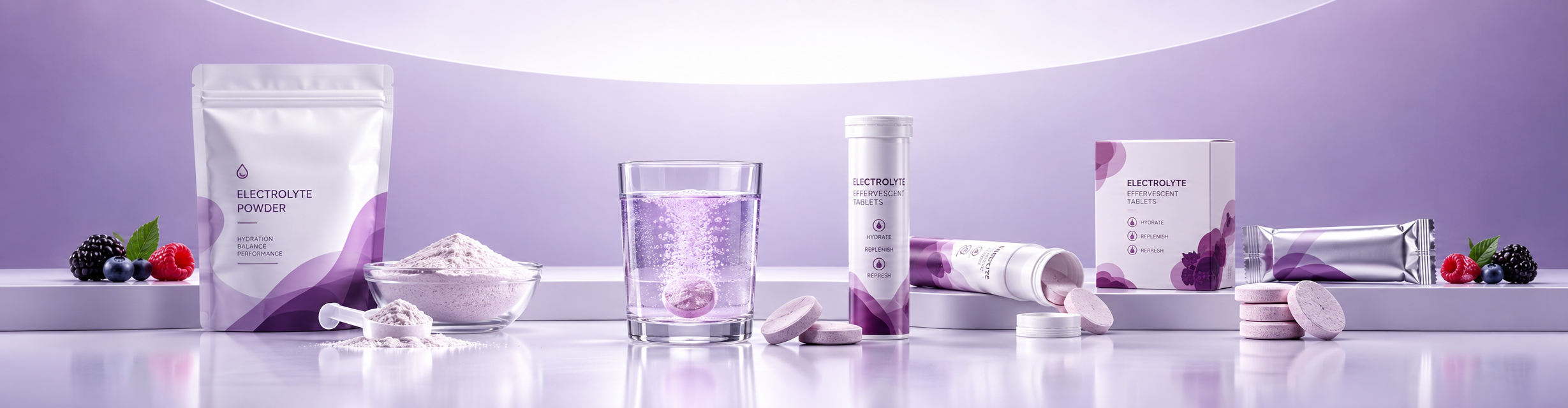
Tube vs Foil Packaging for Effervescent Tablets
Before requesting a quotation, translate the marketing concept into a dose, material basis, serving, process route, evidence plan, package, and volume range.
Effervescent development succeeds only when dose, acid-base chemistry, compression, humidity control, dissolution, and packaging are designed as one commercial system.
This article focuses on moisture protection, portability, line compatibility and unit economics. The objective is to help a brand reach a defensible next decision, not to imply that one formula, parameter, or format is universally correct.
Quick Answer
What the Brand Should Decide First
Treat dose, acid-base chemistry, room humidity, compression, dissolution, and moisture-barrier packaging as one system. A change to any one of them can change tablet size, stability, MOQ, and cost.
At minimum, obtain clear answers for:
-
Moisture barrier
-
Individual versus multi-use protection
-
Consumer portability
-
Packing-line compatibility
-
Desiccant strategy
-
Component MOQ
-
Cost per serving
The Core Manufacturing Decision
Fix the Product Basis Before the Sales Answer
Strategic objective: Connect packaging choice to stability and cost. In practice, the article and RFQ should lead to a specific dosage-form, evidence, packaging, or commercial decision.
Write mandatory requirements separately from preferences. A supplier can challenge a preferred flavor, unit count, or package; it should not quietly change the target dose or market basis to make the quote easier.
Moisture barrier
What the Brand Should Define and Verify
The decision on moisture barrier must account for exposure during production, component storage, filling, sealing, distribution, and repeated consumer opening.
For moisture barrier, request component specifications, closure controls, line compatibility, integrity checks, and stability in the proposed commercial pack.
Approve moisture barrier as part of the protection system first and as a branding choice second.
Individual versus multi-use protection
What the Brand Should Define and Verify
Individual versus multi-use protection is a decision input rather than a promotional label. Define who supplies the information, which document controls it, and what outcome is acceptable.
Ask each candidate to show how individual versus multi-use protection is documented, verified, priced, and approved within the proposed project.
Resolve individual versus multi-use protection before final quotation so suppliers do not price different interpretations of the requirement.
Consumer portability
What the Brand Should Define and Verify
A technically feasible product can still fail on consumer portability if the serving, preparation, swallow burden, taste, portability, or package conflicts with the use occasion.
Evaluate consumer portability through the complete directions and serving with the intended user profile, not only a single unit in an internal tasting.
Use evidence on consumer portability to choose among technically credible formats, not to justify an unworkable dose.
Packing-line compatibility
What the Brand Should Define and Verify
Packing-line compatibility is a decision input rather than a promotional label. Define who supplies the information, which document controls it, and what outcome is acceptable.
Ask each candidate to show how packing-line compatibility is documented, verified, priced, and approved within the proposed project.
Resolve packing-line compatibility before final quotation so suppliers do not price different interpretations of the requirement.
Desiccant strategy
What the Brand Should Define and Verify
The decision on desiccant strategy must account for exposure during production, component storage, filling, sealing, distribution, and repeated consumer opening.
For desiccant strategy, request component specifications, closure controls, line compatibility, integrity checks, and stability in the proposed commercial pack.
Approve desiccant strategy as part of the protection system first and as a branding choice second.
Component MOQ
What the Brand Should Define and Verify
The cost of component moq may be driven by process batch, ingredient purchase, printed components, tooling, setup, testing, or freight configuration.
For component moq, separate fixed charges, variable unit cost, unused component inventory, price tiers, yield assumptions, and reorder economics.
Approve the budget for component moq from cash exposure and realistic sell-through, not only from the lowest quoted piece price.
Cost per serving
What the Brand Should Define and Verify
An error in cost per serving changes total mass, unit count, excipient space, package size, and cost per serving.
For cost per serving, request the calculation showing material assay, theoretical input, amount per unit, amount per serving, and finished release basis.
Do not approve cost per serving until the meaningful amount fits a consumer-acceptable serving without relying on an undefined overage.
Manufacturing Mechanics
Effervescent Tablet Engineering
The acid and carbonate components must remain dry before use but react predictably in water. That makes environmental exposure, blend order, compression behavior, and immediate packaging part of one system.
Tablet mass is shared by the active ingredients, acid-base pair, sweetener, flavor, lubricant, and processing aids. A dose that fits a powder scoop may require an impractically large effervescent tablet or more than one tablet.
Compression must create enough mechanical strength for handling without making dispersion unacceptably slow. Hardness, porosity, friability, ejection, and dissolution therefore need to be developed together.
Ask the supplier to label every technical statement as established commercial experience, pilot evidence, laboratory observation, or proposed development work. Those evidence levels should not be presented as equivalent.
Control and Evidence Plan
What to Review Before Release
The control plan should concentrate on the failure modes created by this formula and format. Relevant controls include:
-
Controlled room humidity and exposure time
-
Blend uniformity and segregation controls
-
Tablet weight, thickness, hardness and friability
-
Defined effervescence or dispersion endpoint
-
Rapid transfer into a qualified moisture-barrier package
The corresponding evidence package may include:
-
Environmental records for the commercial run
-
Compression and in-process weight data
-
Beginning-middle-end samples
-
Dissolution observations under a defined method
-
Seal, closure and package-integrity evidence
The test plan should identify sample type, sample location or selection method, units, method, specification, laboratory, timing, and the action taken when a result is atypical or out of specification.
Commercial Model
Compare the Complete Serving and Launch Commitment
The commercial comparison should include:
-
Tooling and line changeover
-
Tube or foil component MOQ
-
Tablet count and shipping volume
-
Desiccant and closure system
-
Testing and release lead time
Include the inventory consequences of packaging print runs and ingredient minimums. Materials left behind at the factory still represent brand cash and obsolescence risk.
Supplier Questions
Questions That Expose the Real Capability
-
What relative-humidity range and exposure limit are used?
-
What tablet mass and diameter are realistic at the target dose?
-
How is the dissolution endpoint defined?
-
Which package configuration has been assessed with this formula?
-
What part of the quoted MOQ is driven by batch size and what part by packaging?
-
What commercial evidence supports the proposed approach to moisture barrier?
-
What commercial evidence supports the proposed approach to individual versus multi-use protection?
-
What commercial evidence supports the proposed approach to consumer portability?
-
Which quotation assumptions can change after sampling?
-
Who approves formula revisions, deviations, packaging changes, laboratory results, and final release?
Red Flags
When to Pause the Project
-
MOQ is stated without identifying the process, material, component, tooling, or test driver
-
The quotation excludes material items but does not state the exclusions
-
The supplier confirms feasibility before receiving dose, material, serving, market, and package details
-
The answer to moisture barrier is promotional rather than measurable
-
A laboratory sample is described as proof of routine commercial performance
-
The raw-material COA is offered as the finished-product result
-
One shelf life or standard test panel is applied to unrelated formulas
-
Certificate logos are shown without holder, facility address, scope, validity, and verification route
How VitaMFG Approaches the Project
Review Effervescent Packaging
VitaMFG reviews the project from the intended serving backward: ingredient basis, dose, format, market, consumer experience, process risks, package, testing, order quantity, and forecast.
VitaMFG presents practical alternatives before sampling; facility credentials do not replace product-specific release and stability evidence.
Frequently Asked Questions
Q1: Can this project be quoted accurately without a full brief?
A range is possible, but the supplier should list every assumption and exclusion. The quote becomes actionable after feasibility and specification review.
Q2: Does a successful sample prove the product is ready?
No. The sample is one development gate. Commercial equipment, run time, transfers, filling or compression, packaging, and repeatability may change the outcome.
Q3: What is the most useful first document to send?
Begin with the consumer promise and complete serving, then add material grades, exclusions, claims, packaging, evidence expectations, and commercial quantities.
Final Recommendation
Choose a route that remains credible from formula calculation through production, release, storage, consumer use, and reorder economics.
With the target dose, market, serving, package, and volume defined, the next step is: Review Effervescent Packaging.
Reference Links
-
U.S. FDA — Dietary Supplement CGMP Compliance Guide
-
Electronic Code of Federal Regulations — 21 CFR Part 111
-
Effervescent tablet formulation review