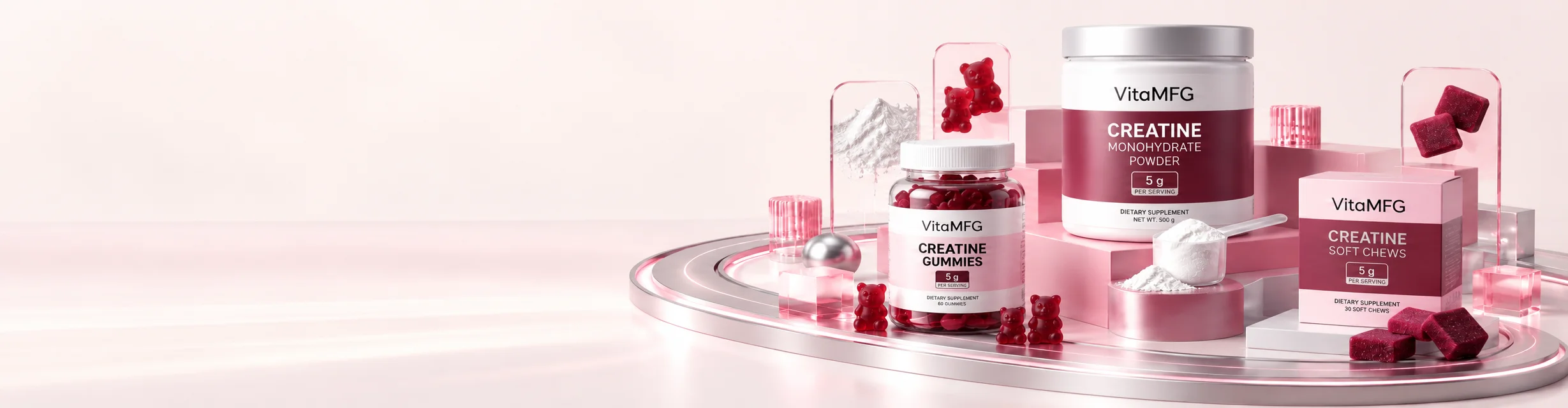
How to Turn a Creatine Powder Into a Soft Chew
Creatine powder is efficient because the serving is mostly creatine. A soft chew must preserve that dose while adding enough structure, binding, flavor, and moisture control to create a stable, portable unit.
The most important decision is serving architecture. A 5g creatine target could be divided across two 5g chews containing about 2.5g creatine each, or across more smaller pieces. Fewer units increase the active percentage and technical difficulty.
A successful transfer therefore begins with dose and commercial equipment, not with selecting a candy flavor.
Quick Answer
Design a High-Load Delivery System
The development path should define:
-
Creatine form and 5g dose basis
-
Chews per serving and unit weight
-
Target active percentage
-
Binding and texture system
-
Flavor masking and full-serving sensory profile
-
Processing temperature and hold time
-
Final moisture and water activity
-
Finished-product assay and sampling
-
Packaging and transport protection
-
Commercial forming and repeat-batch capability
A hand-formed mixture that contains 50 percent creatine is not automatically a commercial soft chew. It must run consistently through mixing, forming or depositing, cutting, coating or wrapping, and packaging.
Lock the Powder Product Facts
Preserve the Meaning of the Original Dose
Confirm whether the powder delivers 5g creatine monohydrate, 5g declared creatine, or another basis. Record the raw-material supplier, assay, particle characteristics, and current test specifications.
Also identify any ingredients that belong only to the powder experience, such as drink flavors, large acid systems, anticaking agents, or instantizing components. They may not transfer directly to a chew.
If the powder includes electrolytes, amino acids, stimulants, or botanicals, calculate the total active mass and review each material's taste and compatibility.
Choose the Serving Architecture
Two Chews, Three Chews, or More
Suppose the target is 5g creatine monohydrate per serving:
-
Two chews require 2.5g per unit
-
Three chews require about 1.67g per unit
-
Four chews require 1.25g per unit
The lower the unit count, the higher the powder load. Larger chews may feel substantial, while smaller multiple pieces increase package count and consumer burden.
Model the full serving mass, chew time, package count, days of supply, and cost. A two-chew serving can create strong differentiation if the texture is acceptable and the process is repeatable.
Select the Creatine Material
Particle Behavior Affects Texture and Processing
Creatine monohydrate materials can differ in particle size, agglomeration, flow, and sensory perception. Fine particles may reduce obvious grit but increase surface area and influence binding. Coarser particles may create a sandy bite.
Review:
-
Identity and purity specification
-
Particle-size distribution
-
Bulk density and flow
-
Moisture
-
Flavor and odor
-
Supplier and origin documentation
-
Finished-product method compatibility
Do not choose a material only from price per kilogram. At 50 percent load, its physical behavior becomes part of the chew structure.
Build the Binding System
Hold a Large Powder Mass Without Becoming Hard or Sticky
The chew needs a continuous phase that binds creatine and other solids. Depending on the platform, this may involve syrups, soluble fibers, fats or oils, humectants, hydrocolloids, proteins, or other structure-forming ingredients.
The system must balance:
-
Cohesion
-
Chew resistance
-
Elasticity or softness
-
Crumbling
-
Surface oil or tack
-
Moisture migration
-
Flavor release
-
Equipment forming behavior
Increasing binder can improve cohesion but reduce active percentage or create a sticky product. Reducing binder can produce a dry, crumbly chew.
Cold-Processed and Lower-Heat Routes
Reduce Exposure Without Claiming Zero Heat Everywhere
A cold-processed or lower-heat soft-chew platform can reduce the prolonged cooking exposure associated with some confectionery systems. The exact process still needs to define material temperature, mixing energy, hold time, and any warming used for binding or forming.
For creatine, the key variables include water, pH, temperature, and time. Dry creatine is stable, while conversion in solution generally increases under acidic and warmer conditions over time.
The manufacturer should document the actual process instead of relying on a broad “cold processed” claim as proof of stability.
Flavor Masking
Creatine Is Mild, but Fifty Percent Powder Changes the Bite
Creatine monohydrate may not be intensely bitter, yet a high powder proportion can create dryness, chalkiness, and lingering particle perception.
Flavor development should balance:
-
Sweetness
-
Acid level
-
Salt
-
Aroma intensity
-
Fruit or confectionery direction
-
Lubricity and mouth-coating
-
Aftertaste
-
Texture after storage
Strawberry, mango, blue raspberry, citrus, and other bold profiles can be explored, but the selected flavor should be approved in the full 5g serving.
Water Activity and Moisture
A Soft Texture Requires Controlled Water Availability
Moisture content and water activity are related but different. The chew needs enough plasticity for a soft bite, while excessive available water can increase physical, chemical, or microbiological risk.
Measure:
-
Incoming material moisture
-
Batch water and liquid components
-
Final moisture
-
Water activity after equilibration
-
Texture at release and during storage
-
Package moisture transfer
There is no universal water-activity target suitable for every soft chew. The specification must be linked to formula, process, packaging, and shelf-life data.
Forming and Commercial Equipment
The Formula Must Match the Line
High-load dough or mass can behave differently from gummy slurry. Commercial options may involve extrusion, sheeting, cutting, molding, depositing, or other forming systems.
Evaluate:
-
Mixer torque and powder incorporation
-
Uniformity of the mass
-
Temperature during mixing
-
Transfer and hold time
-
Forming pressure
-
Piece-weight control
-
Cutting or release
-
Surface treatment
-
Wrapping or bottle filling
An experimental material that works by hand may be too stiff for the mixer, too adhesive for the former, or too fragile for packaging.
Finished-Product Creatine Testing
Verify the Chew, Not Only the Input
The testing plan should cover raw-material identity, controlled weighing, batch records, representative finished-product sampling, suitable analytical methods, and batch-specific release results.
The soft-chew matrix may contain fibers, syrups, fats, acids, flavors, and other actives that affect sample homogenization and extraction.
Report creatine per chew and per serving. Where relevant to the stability question, monitor creatinine as a related conversion product.
Beginning-middle-end samples can help evaluate distribution during forming. A single composite average may not show unit variation.
Stability Program
Follow Chemistry, Texture, and Package Together
A soft chew can pass initial potency and later harden, dry, deform, oil out, stick, discolor, or change flavor.
Monitor as appropriate:
-
Creatine potency
-
Creatinine
-
Moisture and water activity
-
Texture and chew resistance
-
Appearance and color
-
Odor, flavor, and aftertaste
-
Microbiology
-
Package integrity
Accelerated work can identify early risks and compare versions. Real-time data supports the intended storage period. The package used in the study should represent the commercial configuration.
Packaging Options
Protect Shape, Moisture, and Convenience
High-load soft chews may be individually wrapped, placed in pouches, packed in trays, or bottled depending on surface, deformation, and consumer use.
Individual wraps improve portability and unit protection but increase material and packing cost. Bottles can be efficient but may allow pieces to rub, deform, or exchange moisture.
Evaluate seal integrity, oxygen and moisture barrier, light exposure, heat during distribution, package count, and consumer opening frequency.
Cost and Commercial Positioning
Compare Against the Powder Serving, Not a Candy Piece
Powder will often remain less expensive per 5g creatine serving. The soft chew must justify its premium through portability, full-dose convenience, taste, fewer pieces, and brand differentiation.
Compare:
-
Creatine per serving
-
Total serving mass
-
Chews and wraps per package
-
Development and scale-up
-
Testing and stability
-
Packaging and freight
-
Retail price and margin per serving
Do not compare a 5g powder serving with a low-dose chew that requires consumers to take an impractical number of pieces.
Common Development Failures
-
Setting two chews before testing 50 percent load
-
Choosing material only by chemical specification
-
Approving flavor in a reduced-dose sample
-
Ignoring mixer torque and forming equipment
-
Treating “cold processed” as stability proof
-
Using theoretical input as finished-product potency
-
Defining softness without moisture and water activity
-
Approving fresh texture without storage data
-
Selecting packaging after scale-up
How VitaMFG Develops Creatine Soft Chews
Dose First, Then Texture and Process
VitaMFG reviews the 5g target, creatine material, maximum chews per serving, unit weight, flavor, dietary positioning, target market, package, testing, and volume.
The soft-chew route is evaluated around high powder loading, binding, cold-processed or lower-heat handling, flavor masking, water activity, forming equipment, finished-product verification, stability, and commercial repeatability.
Where the desired two-chew architecture conflicts with texture or equipment, the serving count, unit weight, or supporting formula is adjusted before packaging investment.
Frequently Asked Questions
Q1: Can one soft chew deliver 5g creatine?
A single chew would require a very large or extremely high-load unit. Two or more pieces are generally more practical for consumer experience and manufacturing.
Q2: Is a soft chew just a low-moisture gummy?
No. It uses a different structural approach and can carry more powder. Its formulation, forming, packaging, and stability controls are distinct.
Q3: Does cold processing prevent creatine degradation?
It can reduce heat exposure, but finished-product stability still depends on water, pH, time, storage, and package. Testing remains necessary.
Final Recommendation
Build the Chew Around a Verified Five-Gram Serving
Turning creatine powder into a soft chew requires a high-load structure that consumers can chew and a commercial process that can reproduce the dose.
If you have defined the creatine source, target serving, preferred chew count, flavor, and package, VitaMFG can perform an initial soft-chew feasibility review.